ByJohn A
Building a Hyperlocal Delivery App: Connecting Nearby Merchants With Customers in 30 Minutes
| On This Page 1. What Hyperlocal Delivery Actually Is 2. The Hyperlocal Business Model 3. Merchant-Customer Radius Matching: The Core Engine 4. The 30-Minute Delivery Architecture 5. The Tech Stack for a Hyperlocal Platform (2026)6. Cost, Timeline, and Building It in India 7. Real Case Study: A Scalable, Real-Time Marketplace 8. Best Practices and Common Mistakes 9. FAQs |
Summary
What is hyperlocal delivery and how does it work? As CIO at Acquaint Softtech, I lead technology solutions that help businesses build fast, scalable delivery platforms through our software product development services. Hyperlocal delivery success depends on one thing: speed.
It requires real-time tracking, location-based matching, and a strong architecture to deliver orders in minutes. We build hyperlocal and last-mile platforms where customers, merchants, and riders connect seamlessly, helping businesses scale across markets.
Market data from Statista shows quick commerce among the fastest-growing retail segments, which is exactly why the engineering, not the idea, decides who wins.
This article is a deep dive into how hyperlocal actually works, written from real delivery experience rather than generic, scraped advice. We will define the model, explain the economics, go deep on radius matching and the 30-minute architecture, then cover the stack, the cost, and a real client build so the advice stands on shipped work. It sits inside our wider on-demand app development guide.
What Hyperlocal Delivery Actually Is
Hyperlocal delivery is an on-demand model that connects customers with merchants in their immediate area, shops, restaurants, pharmacies, and grocers, and fulfils orders in under an hour through a local fleet of delivery partners.
The defining constraint is distance: because the merchant and the customer are close, the delivery is short, and the time stays small. Dunzo, Blinkit, and Gorillas built large businesses on exactly this idea, which is why serious operators treat the platform as a real product and bring in software development outsourcing partners rather than a template. The model is simple to describe and unforgiving to build.
The Dunzo model in one view
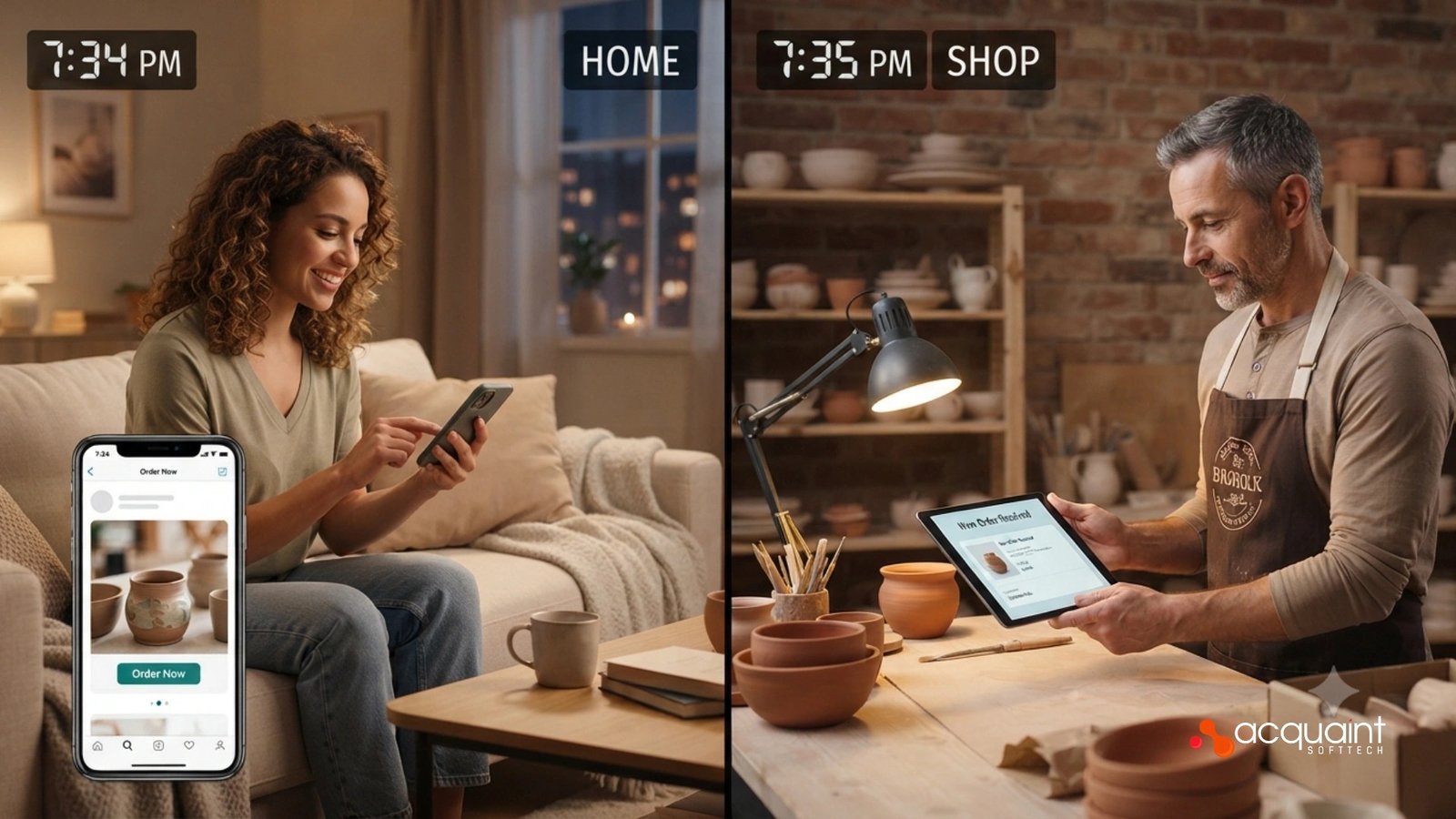
The platform has up to four sides that must stay in sync in real time: the customer app, the merchant, the delivery partner app, and the admin dispatch panel. An order flows from a tap to a nearby merchant to the closest available rider to the customer’s door, all within minutes, the same coordination challenge we cover in our on-demand delivery app development guide. Some platforms hold their own dark-store inventory for speed, while others aggregate existing local shops. Either way, the clock is the product.
Before any feature is built, the model and geography have to be pinned down: dark stores or merchant aggregation, which categories, what radius, one neighbourhood or a whole city. Each answer cascades into the matching engine, the fleet model, and the unit economics, so we map it in a discovery workshop first. A three-kilometre grocery service is a different machine from a citywide parcel network. Deciding this early is the cheapest decision you will ever make.
The Hyperlocal Business Model
The hyperlocal business model earns from a mix of delivery fees, merchant commissions, and convenience charges, but its real challenge is unit economics: every delivery has a hard cost in rider time and fuel that a short radius is meant to contain.
The model only works when the average delivery is short, the rider stays busy, and the order value justifies the trip. Building the commission, pricing, and payout logic that keeps those economics honest is real backend work, which is why teams hire Laravel developers to get it right. Speed is the promise, but unit economics is the business.
How the money actually works
Most platforms combine revenue streams: a delivery fee from the customer, a commission from the merchant, surge or small-cart fees at peak, and sometimes subscriptions for free delivery. The cost side, riders, fuel, and idle time, is the same last-mile maths we break down in our on-demand courier service app guide. The platforms that survive are the ones that batch orders, keep riders moving, and keep the radius tight. Density beats reach in this business.
Getting the economics wrong is the most common way hyperlocal startups die, because a model that loses a few dollars per delivery loses millions at scale. Modelling the pricing, radius, and batching before launch is a strategic decision best made with senior guidance, which is exactly what a virtual CTO provides. The maths has to work on a spreadsheet before it can work in an app. Validate the economics first, then build the product.
Read Also: Massage Columbus in Ohio Is Helping Busy Lives Feel More Balanced Again
Merchant-Customer Radius Matching: The Core Engine
Radius matching is the core engine of a hyperlocal app, because the entire speed promise depends on never sending a rider far. When an order arrives, the system finds merchants within a small radius that have the item available, finds the closest free rider, and optimises the pickup and drop sequence, all in seconds.
Building that geospatial, real-time logic reliably is the focus of our dedicated development teams. Match well, and the delivery is fast and cheap; match poorly and both promise and margin collapse.
What the matching engine must do
• Geofence merchants and riders: only consider those inside the delivery radius.
• Check real-time availability: confirm the merchant actually has the item.
• Rank riders smartly: by distance, ETA, and current load, not just proximity.
• Batch nearby orders: combine trips that share a route to cut cost.
• Reassign instantly: recover from a decline or delay without losing minutes.
The matching problem is a close cousin of ride-hailing, where the nearest driver is paired to a rider in milliseconds, a flow we detail in our taxi booking app guide. Hyperlocal adds the merchant as a third point, so the engine optimises a triangle, customer, merchant, and rider, rather than a line. Geospatial queries, run thousands of times a minute, are the beating heart of the system.
This is also where data and smart algorithms separate winners from clones, by predicting demand, pre-positioning riders, and batching orders that share a route. Teams building that layer often hire Python developers for the geospatial and optimisation work. A matching engine that quietly shaves a minute and a few cents off every order is worth more than any single feature. Optimise the triangle, and everything else gets easier.
The 30-Minute Delivery Architecture
Delivering in 30 minutes is an architecture decision long before it is an operations one, because the system has to react in real time at every step. The answer is event-driven design: an order triggers an instant cascade of merchant acceptance, rider assignment, live tracking, and status updates, with no slow batch jobs in the path.
Cross-platform apps keep the customer and rider experiences fast and affordable, which is why teams hire React Native developers to ship them together. Speed is built in, not bolted on at the end.
How Dunzo delivers so fast
The speed comes from three things working together: a tight radius so distance is small, real-time matching so no time is wasted, and infrastructure that absorbs demand spikes without slowing, the deployment patterns we cover in our MERN stack app deployment guide. Dark stores or pre-positioned riders cut the first mile, while live tracking and smart batching cut the last. Every second saved compounds across thousands of orders a day.
The invisible layer is operations under load. Real-time tracking, push notifications, and matching all run continuously, and a peak-hour surge cannot be allowed to add even seconds of latency. Strong DevOps engineers with autoscaling and monitoring are what keep the 30-minute promise during the evening rush. The architecture that looks fast in a demo must stay fast at ten thousand orders an hour.
The Tech Stack for a Hyperlocal Platform (2026)
A 2026 hyperlocal platform pairs cross-platform mobile apps with a real-time, event-driven backend, a geospatial database, and a mapping layer. React Native or Flutter cover the customer and rider apps; a Node.js or Laravel backend runs orders, matching, and payouts; and live location streams over WebSockets backed by Redis and a geospatial store such as PostGIS. Many teams build on a single JavaScript foundation, so founders hire MERN stack developers who can own the customer, merchant, rider, and admin apps together.
| Layer | Recommended Tech | Role |
| Mobile apps | React Native / Flutter | Customer and rider apps |
| Backend | Node.js / Laravel | Orders, matching, payouts |
| Real-time + geo | WebSockets, Redis, PostGIS | Live tracking, radius matching |
| Cloud + maps | AWS, Maps APIs | Scale, routing, uptime |
Why architecture beats any framework
Architecture matters more than any single library you pick. Hyperlocal is a real-time, geospatial, high-concurrency problem, so the system must run location queries and dispatch decisions constantly without blocking. The backend choice between a PHP and a JavaScript stack is a genuine trade-off, which we weigh in Laravel vs MERN stack. Pick for your team and your scale, not for whatever is trending this quarter.
Integrations are the other half of the build. Maps, payments, SMS, and merchant point-of-sale systems all connect here, each with its own cost, rate limits, and failure modes that must be handled gracefully.
Owning those integrations across multiple apps is why teams hire MEAN stack developers who can keep one consistent codebase. A clean architecture today is what keeps the platform cheap to change tomorrow.
Cost, Timeline, and Building It in India
A focused hyperlocal MVP, with one zone, one category, customer and rider apps, and core matching, typically starts in the mid-five figures, while a full multi-zone platform with merchant aggregation, batching, and analytics runs into six figures.
Timelines follow the same curve: a few months for an MVP, longer for a scaled network. Teams keep both under control by hiring remote developers on a flexible model instead of carrying a fixed local payroll before revenue exists.
| Build | Typical Cost | Timeline |
| MVP, one zone | From ~$35,000 | 3 to 5 months |
| Growth platform | $80,000+ | 5 to 8 months |
| Multi-zone, full features | $150,000+ | 8 months and up |
Why building in India changes the maths
Geography is the biggest single lever on what you spend. India-based teams deliver the same quality at up to 40% lower cost than Western agencies, the saving documented in our story on how a startup saved $60K a year on remote hiring. In a thin-margin business like hyperlocal, that gap can be the difference between reaching launch and running out of runway. Cheaper hours buy more time to make the economics work.
Cost is also about decisions made before any code is written. A matching engine or pricing model bolted on late can cost more than the original build to fix, and a clone built for single, slow deliveries cannot become real-time without a painful version upgrade. Designing for speed and scale from the start is far cheaper than retrofitting it later. Build for the network you want, not just the demo you need.
Real Case Study: A Scalable, Real-Time Marketplace
The clearest proof of how we build a fast, real-time, two-sided marketplace is Lampoo, a luxury resale platform we engineered for scale and speed, documented in our Lampoo case study.
Although it sells fashion rather than groceries, the engineering is exactly what a hyperlocal app needs: a two-sided marketplace connecting many sellers to many buyers, real-time inventory synchronisation, instant search across thousands of items, scalable shipping logic, and performance that holds during traffic spikes. We built it custom so it could grow globally without buckling.
| 1000s+ Unique SKUs with instant searchReal-time inventory synchronisation across systemsUK + Global Ready for local and international operationsScalable: Built to grow with your business expansion |
Why it maps onto a hyperlocal app
Swap a seller for a local merchant and a SKU for an item on a shelf, and the primitives line up cleanly: real-time availability so nothing is sold that cannot be fulfilled, instant search so customers find what is near them, logistics integration for delivery, and caching and optimisation so the platform stays fast under load.
These are the disciplines verified clients praise, summarised in our Clutch recognition overview, and you can browse more delivered work on our case studies page. The fashion is incidental; the engine is the point.
| Capability | What we built for Lampoo | Hyperlocal equivalent | |
| Two-sided marketplace | Many sellers, many buyers | Merchants and customers | |
| Real-time inventory | Synced to prevent overselling | Live merchant stock | |
| Instant discovery | Search across thousands of SKUs | Find nearby merchants fast | |
| Scale under load | Caching, traffic-spike ready | Peak-hour order surges | |
| Logistics | Scalable shipping and carriers | Last-mile routing | |
The lesson for a hyperlocal platform is that real-time, two-sided products live or die on a custom backend you own and can extend, not a template you rent. A live delivery network also needs steady support and maintenance to keep matching, tracking, and payouts running cleanly as it scales. Speed is not a launch feature; it is a daily operating requirement.
Best Practices and Common Mistakes
Hyperlocal apps fail in predictable ways, and almost none of them are about how the app looks in a pitch deck. The biggest mistakes are launching without tight unit economics, treating matching and real-time tracking as later additions, and ignoring the cold-start problem of too few merchants or riders. Avoiding those needs discipline and someone guarding the scope, which is why a strong project manager is worth more than any single feature on a busy build.
Get these right, avoid these traps
• Do: keep the radius tight and the unit economics honest.
• Do: build real-time matching and tracking from day one.
• Do: solve supply, merchants, and riders before chasing demand.
• Avoid: a Dunzo clone that cannot match or track in real time.
• Avoid: chasing citywide coverage before one zone is profitable.
Choosing the right partner is the decision behind all the others. An experienced team designs for real-time matching, scale, and thin margins from the start; the difference our roundup of the best software product engineering companies explains in depth. The cold-start problem, an app with no merchants or riders, is a strategy issue as much as a software one. Win one zone densely before you spread thin.
There is a faster route that is not a throwaway clone. A properly engineered white label solution you own and customise can give speed without the template trap, when built by a team that understands real-time logistics. The right route depends on your timeline, budget, and ambition, which is the conversation worth having before a line of code is written.
FAQs
How Does Dunzo Deliver So Fast?
Dunzo delivers quickly by matching customers, merchants, and riders within a small service radius. Real-time rider allocation and live tracking reduce delivery time. Dark stores and order batching further improve speed.
How to Build a Hyperlocal Delivery App?
Start with a target delivery zone, service categories, and delivery radius. Build customer, rider, and merchant apps with live tracking and payment integration. Launch in one profitable area before expanding to multiple zones.
How Much Does a Hyperlocal App Cost?
A hyperlocal delivery app cost depends on features, zones, and integrations. An MVP costs less than a multi-zone platform with analytics and merchant aggregation. India-based development teams can reduce overall development costs significantly.
| US Cost | UK Cost | Europe Cost |
| $35,000–$150,000+ | £28,000–£120,000+ | €32,000–€140,000+ |
What Is the Hyperlocal Business Model?
Hyperlocal platforms earn revenue through delivery charges and merchant commissions. Additional income comes from subscriptions, surge pricing, and small-cart fees. Profitability depends on efficient routing and high order volumes.
What Is Hyperlocal Delivery?
Hyperlocal delivery connects customers with nearby stores and service providers. Orders are fulfilled and delivered within a short distance. Most deliveries are completed within an hour.
How Does Merchant-Customer Radius Matching Work?
The system uses geofencing to identify nearby merchants and riders. It checks availability, distance, and rider workload in real time. The best delivery partner is assigned automatically within seconds.
Custom Build or Dunzo Clone: Which Is Better?
A Dunzo clone is suitable for quick market testing and MVP launches. A custom app provides better scalability, flexibility, and ownership. Businesses planning long-term growth usually choose custom development.
What Tech Stack Is Best for a Hyperlocal Delivery App?
React Native or Flutter are popular choices for mobile apps. Node.js or Laravel power the backend with real-time capabilities. Redis, PostGIS, WebSockets, and AWS support fast matching, tracking, and scalability.